

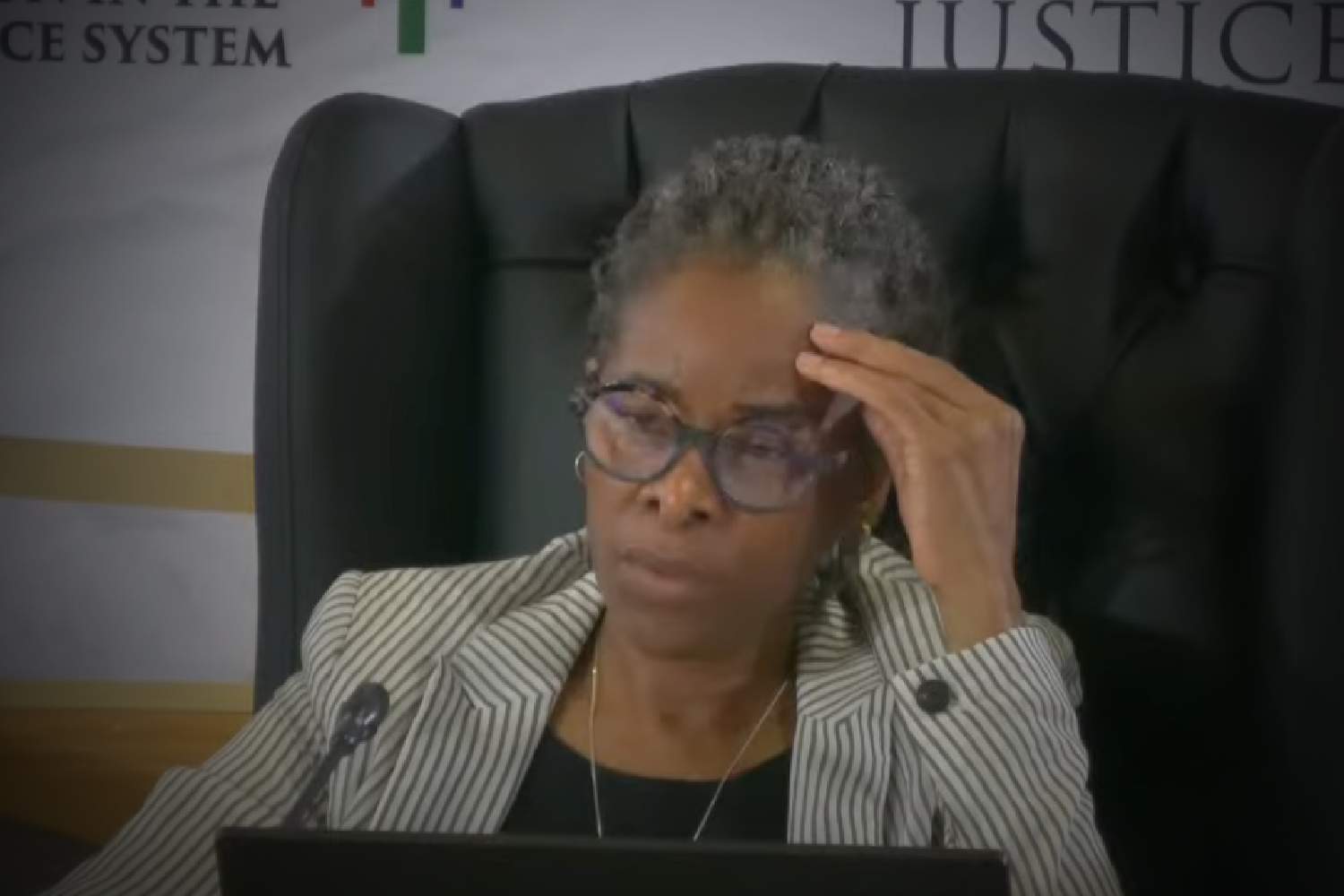
The Madlanga Commission enters its final day of public hearings today, closing a week in which testimony laid bare just how deeply South Africa’s police ministry and senior command structures have been compromised.
Suspended police minister Senzo Mchunu is due back on the stand in Pretoria, following days of evidence about cash payments, blue-light deals and the political killings task team.
DISCLAIMER: Bookmark this page and refresh it shortly before today’s sitting begins. The live stream will appear below once proceedings start.
What this week revealed about money and blue lights
One of the most scrutinised witnesses has been suspended Ekurhuleni metro police deputy chief Julius Mkhwanazi, who admitted receiving money from tender tycoon Vusimuzi “Cat” Matlala while in office.
Concluding his evidence on Thursday, Mkhwanazi told the commission he and Matlala were so close that they “spoke all the time” and that Matlala would send him cash when he was struggling.
“Sometimes he would give me money for petrol or other things. He would give me R500 and R1,000 here and there,” he said, adding that “when I was suspended [in 2022], he used to give [me] money for food.”
Bank records presented to the commission showed three payments totalling R70 000 in 2022 from companies linked to Matlala: R20 000 from Cat VIP in May, R20 000 from Medicare24 in June and R30 000 from Black AK in December.
Evidence leader advocate Sello Mahlape indicated she would argue that the payments were “gratification”, as they coincided with a memorandum of understanding that allowed Matlala’s vehicles to be fitted with blue lights.
Mkhwanazi claimed the money was to help pay for his siblings’ funerals and denied that the payments were bribes for official favours, even as he conceded he had been wrong to sign the blue-lights memorandum.
He told the commission Matlala had promised to “make you happy” if a R360 million SAPS health tender came through, and admitted he had prayed for his associate to land the deal.
Alongside the money trail, the commission heard how Matlala’s private security personnel were deployed to guard Ekurhuleni politicians at state events, sometimes without proper vetting or formal authorisation, reinforcing concerns that politically connected businessmen had penetrated public law-enforcement structures.
How Senzo Mchunu defended disbanding the political killings task team
Against that backdrop, suspended police minister Senzo Mchunu spent hours this week explaining why he issued a directive to dismantle the Political Killings Task Team (PKTT), a specialised unit set up to investigate assassinations of councillors and other political figures.
Mchunu told the Madlanga Commission he had acted within the law when he signed the instruction.
“I wrote the directive, and I take full responsibility for that. I was not influenced by anyone anywhere, not by phone, not by anything,” he said, insisting he wanted to see a “qualitative difference” in the SAPS during his time in office.
Mchunu said he consulted his special adviser, advocate Vusi Pikoli, before finalising the document.
“As I wrote that directive, I was within the constitution and legislative framework, but I did consult special adviser advocate Vusi Pikoli, who then indicated comfort in terms of the exercise of that responsibility,” he told the commission.
He justified the move by pointing to complaints about “unmonitored task team operation resulting in grave human rights abuses”, unclear reporting lines and duplication of functions that strained SAPS resources.
Mchunu argued that it was irrational to concentrate substantial resources on one category of killings when the country faced a much broader murder crisis.
“I don’t think that it is fair to devote substantial resources to one category of killings in the country, which is politically related killings and not any other killings,” he said, adding that permanent SAPS structures like the murder and robbery units needed to be strengthened instead of relying on “a temporal project”.
He maintained that a 2019 SAPS work study and internal reports had long signalled the PKTT was meant to be temporary and that its six-month budget had been allowed to run for years, creating what he described as an “irregular” arrangement.
Critics’ evidence, heard earlier in the commission, painted a different picture, alleging that political pressure and the interests of powerful business figures lay behind the dismantling of the task team and the rise of parallel structures tied to Matlala and his associates.
Those clashes in testimony are likely to be central to how the panel weighs Mchunu’s conduct in its report.
What to expect on the final day
Today, Mchunu is scheduled to return to the Madlanga Commission for what is expected to be his last round of questioning. Commissioners are likely to press him further on:
- the legal basis for his directive to disband the PKTT;
- the extent of his consultations with Pikoli and senior SAPS commanders; and
- how he responded to allegations that politically connected businesspeople were influencing police deployments, tenders and promotions
With the public hearings ending today, the commission will move into a closed drafting phase, working towards an interim report to President Cyril Ramaphosa later this month.
That report is expected to make findings on the blue-lights saga, Matlala’s relationship with senior officers, the fate of the political killings task team and whether the police ministry and top command structures were captured or improperly influenced.
For communities living with political violence and organised crime, the real test will come after the Madlanga Commission wraps up: how quickly any recommendations are implemented, whether compromised officials face consequences, and whether the SAPS and police ministry can rebuild public trust.
